
Historic Architecture Photography: How to Approach It, and 9 Award-Winning Examples
June 3, 2026A historic building has already been photographed. Many times, usually from the same angles, in the same light, by photographers who arrived at the same hour and left with versions of the same image. That is the central challenge of historic architecture photography: how to produce work that is genuinely your own when the subject has been documented so thoroughly and so publicly.
It is also one of the most rewarding disciplines in architectural photography. Historic buildings carry accumulated time in a way that new construction cannot replicate. Their surfaces record weather, use, and repair. Their proportions reflect a different understanding of space and scale. The light that moves through their windows was designed for candles, not cameras. For a photographer who is willing to slow down and read a building rather than simply point a lens at it, historic architecture offers inexhaustible material.
This guide covers what historic architecture photography actually demands, why it is more technically and creatively challenging than it first appears, how experienced photographers approach its specific problems, and eight projects recognised by the Architecture Photography MasterPrize (APMP) in the 2025 edition that showcase what the discipline looks like at its highest level.
What Is Historic Architecture Photography?
Historic architecture photography is the practice of documenting buildings, interiors, and structures of historical significance in a way that communicates both their physical character and their accumulated meaning. It differs from general architectural photography in several important respects.
New buildings can be photographed to a brief: at a specific time, in specific conditions, to show a specific set of qualities the architect or client wants to communicate. Historic buildings are not owned in the same way by any single vision. They have been shaped by multiple periods, multiple uses, and multiple layers of intervention. The photographer’s first job is to understand what they are actually looking at, not just what the building appears to be.
Historic architecture photography also operates across a wider range of typologies than most other architectural photography specialisms. Castles, cathedrals, railway stations, civic buildings, vernacular houses, industrial structures, memorials, and ruins are all within its scope. Each presents different conditions, different access constraints, and different visual challenges. The railway station is lit from multiple artificial sources at inconsistent colour temperatures. The cathedral has windows designed for colour and spiritual effect, not photographic exposure. The castle sits in a landscape that changes with every season and every hour of daylight.
What the best practitioners share, across all of these typologies, is an understanding that historic architecture photography is fundamentally about time: how a building has changed, what it has survived, and what it means to the people who encounter it now.
The Real Challenges of Photographing Historic Buildings
The originality problem
Famous historic buildings have been photographed by professionals and amateurs for decades. The Fitzwilliam Museum in Cambridge, Antwerp Central Station, Nidaros Cathedral in Trondheim: each has an established visual canon of images that most photographers have encountered before they arrive. Working against that accumulated image bank, rather than simply contributing another version of it, requires both research and creative discipline. The photographer who has studied what has already been made has a better understanding of what remains unmade.
Light that was not designed for cameras
Historic buildings were lit for human occupancy, not photographic documentation. Cathedral windows are designed to produce spiritual atmosphere, not balanced exposures. The dynamic range between a stained glass window and the stone floor beneath it can exceed what any camera sensor captures cleanly in a single frame. Railway stations combine daylight from high above with artificial lighting of varying colour temperatures at platform level. The photographer must make decisions about how to handle this complexity: bracketing and compositing, choosing the moments when ambient light brings the scene into a workable range, or embracing the contrast as a characteristic of the space rather than a problem to solve.
Access and restrictions
Many significant historic buildings are managed by heritage organisations, trusts, or religious institutions that impose restrictions on photography. Tripods are frequently prohibited in public areas. Flash is almost universally banned in buildings with light-sensitive surfaces or artworks. Some spaces cannot be photographed at all without a commercial permit. Interiors that are open to the public during visiting hours are also occupied by other visitors, which complicates any attempt at a clean compositional frame. Researching access conditions, obtaining permits where needed, and identifying times when public traffic is minimal are all prerequisites for serious work in this area.
Converging verticals and spatial distortion
Historic buildings, particularly those with significant height, exaggerate the distortion effects that affect all architectural photography. Pointing a wide-angle lens upward at a cathedral nave produces converging verticals that, if unmanaged, undermine the sense of scale and proportion the building is designed to convey. Perspective control lenses, medium format cameras with view camera movements, and post-processing corrections are all tools for managing this problem. None of them is a complete solution, and the choice between technical correction and allowing some convergence as an honest record of spatial experience is a genuine creative decision in historic building photography.
The crowds problem
Busy historic sites present one of the most practically demanding challenges in the discipline. The most commonly visited buildings are most commonly photographed during the hours when they are most crowded. Practical strategies include shooting at opening time, during off-season visits, using long exposures to remove moving figures through motion blur, or taking multiple frames for compositing in post-processing. Modern AI-based tools have made crowd removal more accessible, though they raise honest questions about whether the result accurately represents the space as it is actually experienced.
How Experienced Photographers Approach Historic Architecture
Research before arrival
Photographers who produce the strongest work in historic settings almost universally describe preparation as the majority of the work. Understanding a building’s history, its architectural periods, its original function, and its subsequent uses informs every compositional decision made on site. Knowing that a particular window was inserted in the 18th century to replace an original Romanesque opening, or that a station concourse was doubled in the 1930s, shapes how a photographer reads the building’s spatial logic and what they choose to make visible.
Reading the light in advance
The direction and quality of light in a historic building changes across the day and across the year in ways that can be anticipated with available tools. Sun position apps, time-lapse studies of online images, and conversations with other photographers who have worked in the same location all contribute to an understanding of when a building reveals itself most fully. Returning to the same building multiple times, across different conditions, is a characteristic of the most considered work in this area. Historic buildings reward persistence in a way that commissioned architectural photography rarely permits.
Finding what has not been made
Working against the established image bank of a well-documented historic building requires the photographer to identify what it has not revealed. This might be a specific time of day when the light creates a relationship between surfaces that standard visiting hours do not capture. It might be a detail, a material, a spatial sequence, that other photographers have passed through without stopping to examine. It might be the building’s relationship to its context: the street, the landscape, the city that has grown up around it since it was built. The photographers whose work appears in awards programs consistently report that their strongest images came from this kind of extended looking, not from executing a predetermined plan.
9 Award-Winning Historic Architecture Photography Projects: APMP 2025
The following nine projects were recognised by the Architecture Photography MasterPrize in the 2025 edition. They span seven countries and cover interior and exterior photography across medieval, Baroque, Victorian, Gothic Revival, modernist, and East Asian heritage typologies. Two photographers, David Valinsky and Warren Diggles, each appear twice, recognised for different projects in the same edition, which reflects the consistency and range demanded by the discipline at its highest level.
-
Fitzwilliam Museum Entrance Hall
David Valinsky | Best of Best, Historic Interior | APMP 2025 | Cambridge, UK
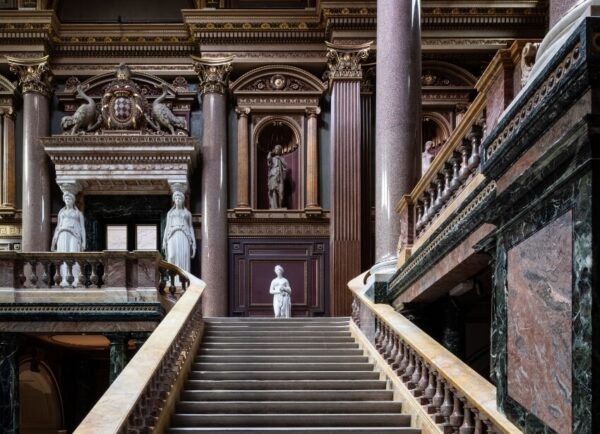
The Fitzwilliam Museum in Cambridge is one of Britain’s great neoclassical interiors: a 19th-century entrance hall of considerable scale and material richness, with polished marble floors, painted ceilings, and a spatial hierarchy designed to communicate institutional authority and cultural seriousness. Valinsky’s interior photography of the entrance hall finds the building at a moment when the light from its high windows falls across the surfaces in a way that reveals their depth and warmth without flattening the room’s three-dimensional complexity.
The photograph is a precise example of what distinguishes the best historic architecture photography from competent documentation: the building is read as a spatial experience, not recorded as a plan. The image conveys the scale, the material quality, and the accumulated presence of a room that has been in continuous use for over 170 years. It is the kind of image that makes someone who has visited the Fitzwilliam feel the building again, and makes someone who has not want to go.
View Fitzwilliam Museum Entrance Hall
-
Antwerpen-Centraal Station: A Crossroads Beyond Time
Onur Guney | Best of Best, Historic Interior | APMP 2025 | Antwerp, Belgium
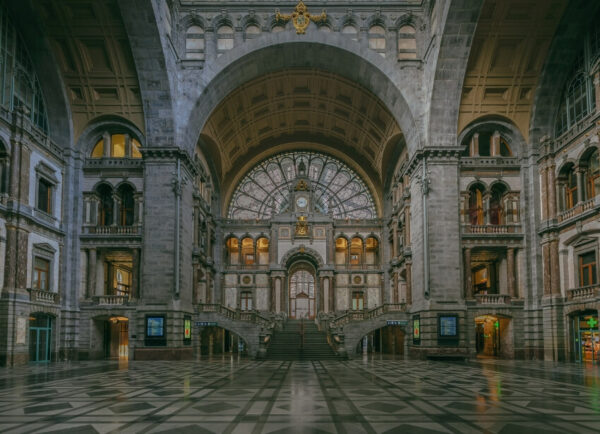
Antwerp Central Station is one of Europe’s most architecturally ambitious railway interiors: a late 19th-century steel and stone structure of cathedral-like scale that was subsequently extended with an underground network of platforms and connections in the 21st century. The building contains multiple architectural periods in active daily use, which makes it one of the most complex and rewarding subjects in European historic architecture photography.
Guney’s photographs address the station’s central spatial challenge: how to convey the extraordinary height of the original concourse while capturing the relationship between the 19th-century structure above and the contemporary infrastructure below. The images work through a rigorous control of vertical lines, which give the space its full measure of scale without the distortion that less considered photography of tall historic interiors typically produces. The title, ‘A Crossroads Beyond Time,’ is not rhetorical. It describes precisely what Guney’s camera finds in the building.
View Antwerpen-Centraal Station: A Crossroads Beyond Time
-
Nidaros Cathedral
Warren Diggles | Historic Interior | APMP 2025 | Trondheim, Norway
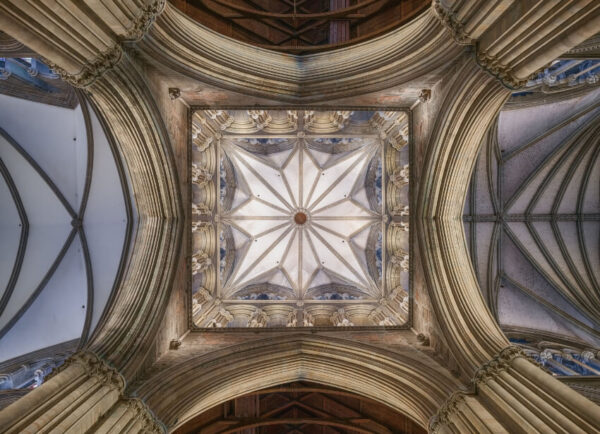
Nidaros Cathedral in Trondheim is Scandinavia’s largest medieval building and one of the most important pilgrimage sites in northern Europe. Its interior has been in continuous religious use for over eight centuries, and it carries the accumulated weight of that history in its stone, its light, and its spatial proportions. Photographing Nidaros is an exercise in working with an architectural interior that was designed to produce a specific spiritual experience, and understanding how to convey that experience through a photographic frame rather than simply recording the building’s physical dimensions.
Diggles’ approach to the cathedral interior uses the quality of the existing light as the primary compositional material. The images do not correct or supplement the cathedral’s natural illumination. They find the moments and angles at which the light, entering through windows designed for colour and atmosphere rather than even distribution, creates a spatial reading of the nave and its proportions that is both accurate and genuinely moving.
-
Old City Hall Interiors
Ulf Wallin | Historic Interior | APMP 2025 | Richmond, Virginia, USA
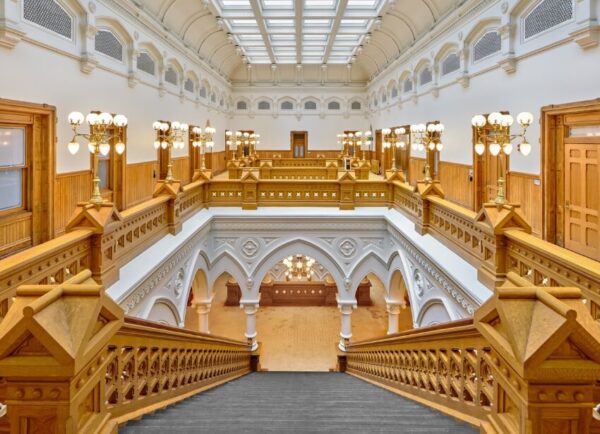
Old City Hall in Richmond, Virginia is a civic building of considerable material richness, its interiors reflecting the accumulated decisions of multiple generations of architects, administrators, and craftspeople. Wallin’s photography approaches the building as a document of American civic culture across time, finding in its rooms and corridors a visual record of the values, materials, and spatial sensibilities that different periods brought to the question of how a public institution should present itself.
The project showcases one of the defining qualities of the best historic architecture photography: the capacity to make a building that is very well known to local audiences look genuinely fresh to a wider international one. Wallin’s images of Old City Hall have the quality of a first encounter, achieved through a combination of careful light selection, precise compositional control, and an evident depth of understanding of the building’s spatial logic that comes from extended familiarity with the subject.
-
Falling Out of Time
Ana Skobe | Historic Exterior | APMP 2025 | Canary Island, Spain
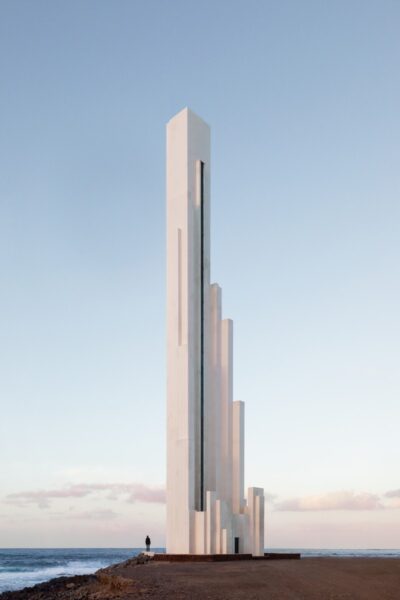
Ana Skobe’s ‘Falling Out of Time’ is an exterior photography project that approaches historic architecture not as a subject to be documented but as a surface through which time is made visible. The title captures the project’s central concern: the relationship between a building’s physical state and the temporal processes, aging, weathering, use, and partial abandonment, that have shaped it.
The project works with historic exteriors in a way that resists the conventional presentation of heritage buildings as finished, preserved objects. Skobe’s photographs find the places where history is most legible: where rendering has fallen away to reveal earlier construction, where vegetation has colonised a wall, where shadow falls across a surface in a way that makes the passage of time a visible presence in the image. This is historic architecture photography as a form of historical thinking, not just visual documentation.
-
Renaissance Awakening
Jan-Tore Oevrevik | Historic Exterior | APMP 2025 | Firenze, Italy
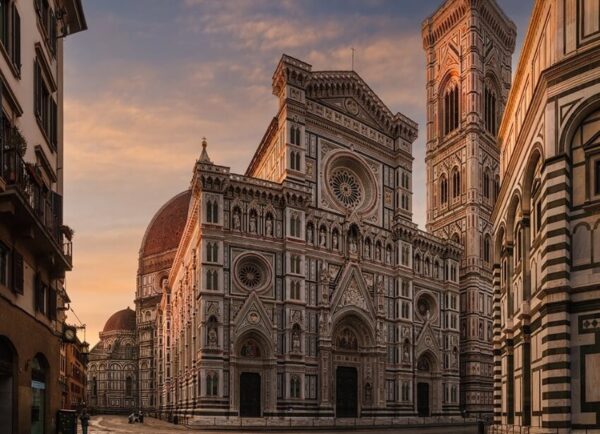
Jan-Tore Oevrevik’s ‘Renaissance Awakening’ is a project centred on the photography of historic exteriors that embody the architectural principles, symmetry, proportion, and material dignity, of the European Renaissance tradition. The title suggests both the historic period and a more active proposition: these buildings, photographed in the conditions Oevrevik finds for them, appear not as static monuments but as living presences.
The project is an example of historic architecture photography in which the photographer’s understanding of the buildings’ architectural language informs every compositional decision. Symmetry is not simply found; it is used. Proportion is not merely recorded; it is demonstrated through framing. The buildings that Oevrevik photographs are given back something of the authority and intention they were designed to project, through an approach to the camera’s placement and the light’s quality that serves the architecture rather than imposing upon it.
-
Fitzwilliam Museum Exterior
David Valinsky | Historic Exterior | APMP 2025 | Cambridge, UK
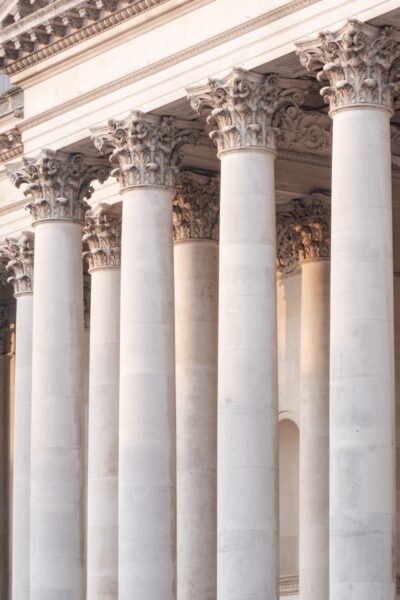
Valinsky’s exterior photography of the Fitzwilliam Museum, recognised in the same APMP 2025 edition as his interior work, demonstrates the range of approach that the most accomplished practitioners bring to a single subject. Where his entrance hall images work with the quality of interior light across surface and volume, his exterior photographs position the museum within the urban landscape of Cambridge with a different set of compositional concerns: the relationship between the building’s neoclassical facade and the street it commands, the way the building reads across different scales and distances, and the light conditions that best reveal the facade’s three-dimensional articulation.
Being recognised in both exterior and interior categories in a single edition is an unusual achievement in competitive architectural photography, and it reflects both the depth of Valinsky’s engagement with this particular building and the breadth of technical and compositional skill that serious historic architecture photography demands.
View Fitzwilliam Museum Exterior
-
Geisel Library
Warren Diggles | Historic Exterior | APMP 2025 | San Diego, USA
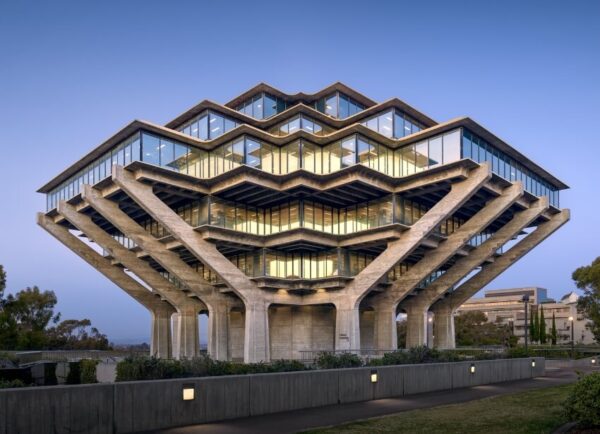
The Geisel Library at the University of California San Diego, designed by William Pereira and completed in 1970, occupies an interesting position in the category of historic architecture photography: it is a building whose significance lies not in medieval or classical heritage but in its status as one of the defining works of American Brutalist architecture. Photographing it requires an understanding of what makes Brutalist architecture visually compelling, the play of form and shadow, the drama of structural expression, the relationship between mass and void, and the ability to convey those qualities in conditions that reveal rather than flatten the building’s spatial ambition.
Diggles, recognised in the same edition for his work at Nidaros Cathedral, demonstrates with this project a range of engagement with the historic category that spans eight centuries of architectural production. His Geisel Library images find the building in light conditions that give full expression to Pereira’s formal intentions, placing the camera at angles that reveal the structure’s dramatic cantilevers and the way the building rises from its surrounding landscape.
-
Shaoxing Yangming Former Residence Memorial Hall
Fang Jia | Historic Exterior | APMP 2025 | Zhejiang, China
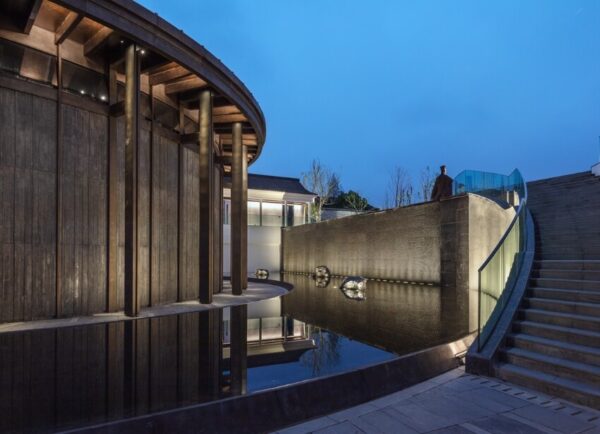
The Shaoxing Yangming Former Residence Memorial Hall is a heritage complex in Zhejiang Province, China, dedicated to Wang Yangming, the 15th-century Confucian philosopher and military strategist. The memorial hall represents a typology of historic architecture that sits outside the European tradition which dominates most international architectural photography discourse: a Chinese courtyard complex whose spatial logic, material character, and relationship to landscape reflect a different understanding of how built space and human experience relate to one another.
Fang Jia’s photography of the complex finds the heritage building in conditions that reveal its spatial and material qualities with precision and patience. The images convey the particular quality of light within a Chinese courtyard complex: filtered, directional, and moving across surfaces of timber, stone, and whitewashed render in ways that reward a photographer willing to wait for the right moment. This project extends the geographic and cultural range of historic architecture photography, making visible a heritage tradition that deserves wider international attention from both photographers and audiences.
View Shaoxing Yangming Former Residence Memorial Hall
Practical Guidance for Photographing Historic Buildings
For photographers approaching historic buildings with serious intent, the following considerations consistently separate work that stands out from work that documents:
- Research the building before you visit:
understand its construction date, its architectural periods, its significant features, and what has already been photographed extensively. This preparation shapes every decision made on site and gives you a basis for finding what remains unmade
- Check access conditions in advance:
many significant historic buildings prohibit tripods, flash, or photography entirely in certain areas. Knowing this before arrival prevents wasted journeys and allows you to plan for the technical constraints you will be working within
- Arrive at opening time or just before closing:
these windows of low occupancy are when the cleanest compositional frames are available in public buildings. For exteriors, the quality of early morning light is also generally superior to midday conditions for buildings with significant surface texture and relief
- Plan for multiple visits:
the best historic architecture photography is rarely made on a single visit. Understanding how the light moves through a building across the day, and returning when the conditions align with your compositional intentions, produces consistently stronger results than attempting to capture everything in a single session
- Use the building’s existing light as your primary material:
resist the tendency to supplement or correct historic buildings’ existing light with flash or supplementary sources. The quality of existing light in a well-considered historic building is typically more interesting than any artificial alternative, and it is more honest to the building’s character
Frequently Asked Questions About Historic Architecture Photography
What equipment do I need to photograph historic buildings?
A wide-angle lens is essential for most historic architecture photography, particularly interiors where spatial constraints prevent shooting from a distance. A full-frame camera with good high-ISO performance is valuable for low-light historic interiors where tripods are prohibited. A perspective control, or tilt-shift, lens is the most effective tool for managing converging verticals in tall spaces, though post-processing correction is an accessible alternative. A tripod is indispensable wherever it is permitted: many historic interiors have light levels that require longer exposures than hand-holding can deliver cleanly. A polarising filter is useful for exterior work on buildings with glazed facades or in locations where sky contrast is a compositional consideration.
How do you photograph historic building interiors without a tripod?
Where tripods are prohibited, the primary strategies are: raising ISO to achieve a shutter speed that eliminates camera shake, using image-stabilised lenses or in-body stabilisation at their limits, bracing the camera against a wall, column, or fixed surface rather than hand-holding freely, and selecting shooting positions that minimise the focal length required for the frame you need. Wide-angle lenses at their widest settings are generally more forgiving of slight camera movement than longer focal lengths. Shooting in RAW and accepting some noise in the file, which can be managed effectively in post-processing at current sensor standards, is preferable to missing the frame entirely.
How do you deal with crowds when photographing famous historic buildings?
The most effective strategies are timing, patience, and technique. Arriving at opening time eliminates most crowds at popular sites. Visiting during off-season periods, particularly for exterior photography where weather is manageable, significantly reduces occupancy at most heritage sites. For interior photography where crowds cannot be entirely avoided, long exposures averaging 20 to 30 seconds will render moving figures as transparent or invisible, though this requires a tripod and available permission to use one. Multiple exposures from a fixed position can be composited to remove people in post-processing. Some photographers choose to include people as a compositional element that gives scale and life to a historic interior, which is a legitimate and often more honest approach to the question of how these buildings are actually used.
Is there a difference between historic architecture photography and heritage documentation?
Yes, and it is an important one. Heritage documentation is a technical discipline concerned with accurate, comprehensive visual recording of a building for archival, conservation, or planning purposes. It follows specific protocols for coverage, lighting, and camera position to ensure that the resulting images serve as reliable records. Historic architecture photography is an interpretive discipline concerned with communicating a building’s character, significance, and spatial experience through images that are also, in the full sense, photographs. The best historic architecture photography is grounded in the same thorough understanding of the building that heritage documentation requires, but its aim is not completeness of record but quality of image. The two disciplines have different standards of success and are not interchangeable, though the skills developed in each inform the other.
Why Historic Architecture Photography Matters
Buildings change. Some are destroyed. Many are significantly altered in ways that remove the features that made them architecturally significant. A photograph of a historic building made with genuine understanding and skill is not simply a record: it is an argument for the building’s value, a demonstration of what it offers to anyone who encounters it with attention and patience.
The photographers recognised by the APMP in the Historic Architecture categories produce work that serves this purpose. Their images of the Fitzwilliam Museum, Antwerp Central Station, Nidaros Cathedral, and the other buildings featured here are not tourist photographs or documentation images. They are interpretations, made by photographers who have spent time with these buildings and found in them something worth the sustained effort of communicating. That is what the discipline, at its best, does.
For photographers considering historic architecture as a focus for their practice, the advice that emerges consistently from the photographers working at this level is simple: slow down, research before you shoot, and understand that the building has more to offer than what you can see in a single visit. The images that stand out in competitions and publications are almost always the result of a relationship with a subject, not a single encounter with it.
Enter the Architecture Photography MasterPrize 2026
The APMP is open to photographers of all levels, with categories covering exterior, interior, historic, landscape, detail, and cityscape photography of the built environment. The Regular Entry deadline is June 30, 2026.
ENTER APMP 2026