Sustainable Architectural Products: What They Are and 4 Award-Winning Examples
June 2, 2026The construction industry accounts for roughly 40% of global carbon emissions. A significant share of that comes not from how buildings operate but from the products that go into them: the insulation, glazing, cladding, systems, and materials that define a building’s embodied carbon before a single occupant arrives.
Sustainable architectural products address this directly. They are building products and systems designed to reduce environmental impact across their full lifecycle: in manufacture, in use, and at end of life. The best of them do not ask architects or clients to accept a performance trade-off in exchange for sustainability credentials. They compete with conventional alternatives on performance, cost, and specification convenience while delivering measurably better environmental outcomes.
This article covers what sustainable architectural product design actually involves, what criteria a jury evaluates when assessing it, and four products recognised by the Architecture MasterPrize (AMP) Product Design Award in the 2024 and 2025 editions that demonstrate what leadership in this category looks like in practice.
What Makes an Architectural Product Sustainable?
The word sustainable is used so broadly in the building industry that it has become almost meaningless without qualification. A product with recycled content is not automatically sustainable. A product with a low-carbon manufacturing process may still create end-of-life waste that undermines its credentials. Genuinely sustainable architectural products address multiple dimensions of environmental impact simultaneously.
The most rigorous framework for evaluating this is lifecycle assessment (LCA), which tracks a product’s environmental impact from raw material extraction through manufacturing, transport, installation, in-use performance, and eventual disposal or recycling. Products that perform well across the full lifecycle, not just at the manufacturing stage, represent the most credible sustainable credentials.
In practice, the criteria that distinguish the strongest sustainable architectural products include:
- Embodied carbon:
the total carbon emissions associated with manufacturing and transporting the product. For insulation, glazing, and cladding, embodied carbon is the primary environmental variable
- Renewable or waste-derived materials:
products made from agricultural byproducts, industrial waste streams, or rapidly renewable biological materials reduce dependence on virgin resource extraction
- In-use performance:
a product that reduces a building’s operational energy use, whether through better insulation, more efficient systems, or improved daylighting, compounds its environmental benefit over the building’s lifetime
- End-of-life strategy:
biodegradable, recyclable, or reusable products avoid the landfill burden that synthetic building materials typically generate at demolition
- Cost competitiveness:
sustainable products that cannot be specified within realistic project budgets remain niche. The most impactful products compete directly with conventional alternatives on cost
4 Award-Winning Sustainable Architectural Products: AMP 2024 and 2025
1. MykoFoam
Mykor | Product Design of the Year, AMP 2024 | Building Envelope & Construction Materials | UK / Portugal
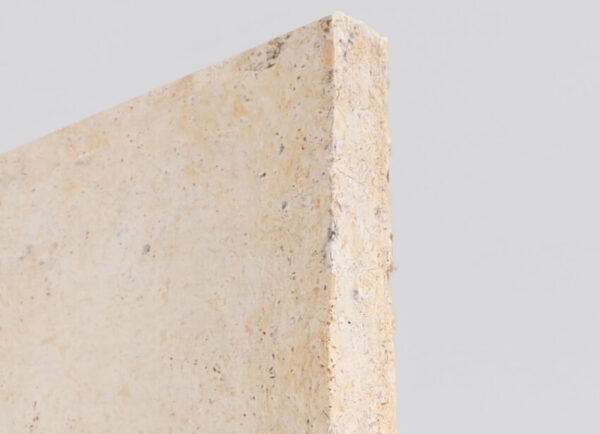
MykoFoam is a rigid insulation panel made from mycelium, the root structure of fungi, grown on cellulosic waste from the paper and pulp industry. Developed by UK-based startup Mykor, it was named the AMP Product Design of the Year for 2024, the program’s highest product honour, in recognition of both its environmental credentials and its practical performance specifications.
The environmental case is compelling and specific. Compared with expanded polystyrene (EPS), Mykor’s manufacturing process consumes 90% less water, 40% less energy, and produces 60% less CO2 emissions. The product’s embodied carbon is 213 kgCO2eq per cubic metre, significantly lower than conventional alternatives. It degrades within one year at end of life, eliminating the landfill burden associated with synthetic insulation. The product is fire resistant, VOC-free, vapour-permeable, and moisture resistant.
On performance, MykoFoam’s thermal properties are competitive with mineral wool, and its sound absorption is rated at 75% at 1000Hz. It costs up to 35% less than other sustainable insulation alternatives, addressing the cost-competitiveness gap that limits adoption of many bio-based building products. Mykor’s founders, including Valentina Dipietro, named to Forbes 30 Under 30 and recognised as a UN Young Champion of the Earth, developed the product to offer architects a credible substitute for plastic-based insulation without a performance penalty. The AMP jury’s decision to award it the program’s highest product distinction reflects the degree to which it succeeds.
2. Automist
Plumis | Best of Best, Equipment / Appliances / HVAC, AMP 2025 | United Kingdom
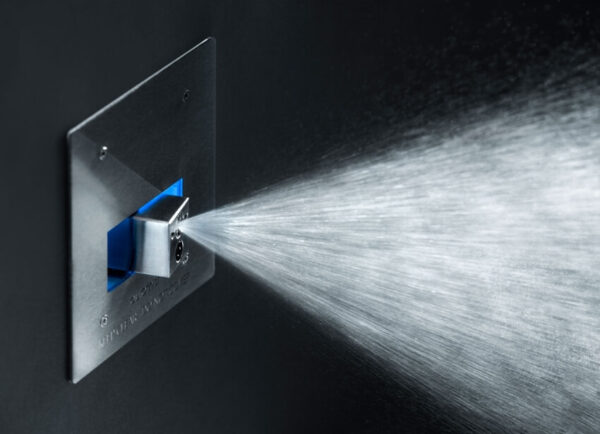
Automist is a water mist fire suppression system developed by London-based Plumis as a direct alternative to conventional sprinkler systems. Its sustainability credentials are primarily about resource efficiency: where a standard sprinkler system discharges approximately 60 litres of water per minute, Automist uses around 2.5 litres, a reduction of over 95%. In a fire event, the water damage to a building and its contents, and the associated waste and reconstruction carbon, can equal or exceed the fire damage itself. Automist’s approach to suppression minimises both.
The product also addresses a significant barrier to fire safety compliance in retrofit and heritage contexts. Conventional sprinklers require extensive pipe networks that are often impractical to install in existing buildings without significant structural intervention. Automist’s compact, wall-mounted format can be integrated into spaces where traditional suppression systems cannot, extending the reach of effective fire protection to older building stock and smaller residential properties. The AMP Best of Best distinction reflects both the product’s technical innovation and its practical implications for how buildings, particularly existing ones, can be protected more effectively and sustainably.
3. Pro Flow Pavers
Pro Flow Pavers | Best of Best, Sustainable Products, AMP 2024 | United States
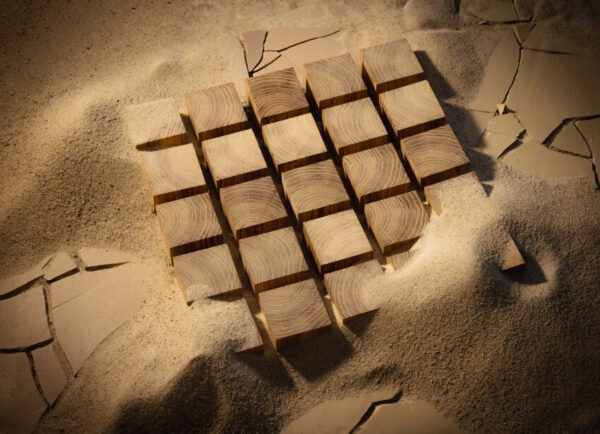
Pro Flow Pavers is a permeable paving system designed to manage stormwater at source rather than channelling it into drainage infrastructure. In conventional hard-surface urban environments, rainwater runs off impermeable surfaces into drainage systems that are increasingly overwhelmed by the intensity of precipitation events associated with changing weather patterns. Permeable paving allows water to infiltrate through the surface and into the ground beneath, reducing peak runoff volumes, recharging groundwater, and filtering pollutants before they enter drainage systems or waterways.
The sustainable product case for permeable paving is well established, but Pro Flow Pavers’ recognition reflects performance and specification qualities that go beyond basic permeability. The system is designed for the load-bearing and durability requirements of commercial and civic applications, not just residential contexts, which significantly broadens its potential application in urban environments where impermeable hardscape is most consequential. As cities face increasing pressure from both water scarcity and flash flooding, products that manage water at the building and site scale rather than relying on municipal infrastructure represent a meaningful contribution to urban resilience.
4. VELUX Skylight System
VELUX | Best of Best, Windows, Doors & Hardware, AMP 2025 | Denmark / International
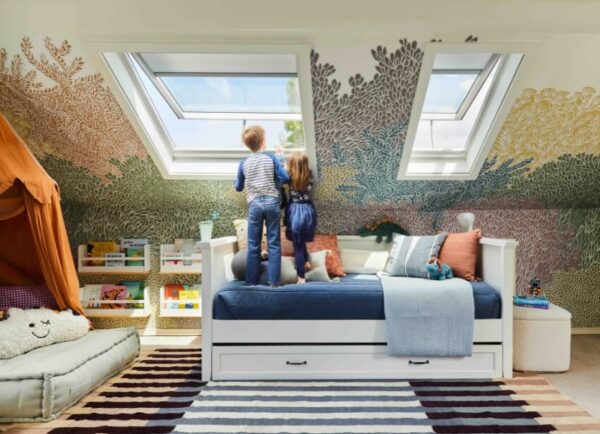
The VELUX Skylight System addresses one of the most consistent performance gaps in building design: the quality and quantity of natural light in interior spaces. Buildings that rely primarily on artificial lighting consume significantly more operational energy than those designed to maximise daylight penetration, and the research on daylight’s effects on occupant health, productivity, and wellbeing is extensive and consistent. A well-designed daylighting product is both a sustainability intervention and a human performance intervention simultaneously.
VELUX’s recognition at the AMP 2025 edition reflects a system engineered for both performance and integration. The product addresses the thermal efficiency of the roof assembly, the quality of diffused light it delivers to interior spaces, and its contribution to passive ventilation, which reduces reliance on mechanical cooling in buildings where natural cross-ventilation is achievable. For a company whose entire product focus is on roof windows and skylights, this kind of integrated performance thinking across multiple sustainability dimensions is what distinguishes the VELUX Skylight System from simpler glazing products. The jury’s Best of Best distinction indicates a product that sets a benchmark within its category rather than simply meeting it.
What the AMP Jury Evaluates in Sustainable Architectural Products
The AMP Product Design Award jury evaluates entries against three primary criteria: innovation, functionality, and overall design excellence. For products in the sustainable categories, this framework rewards products that advance the state of the art rather than simply meeting existing standards.
Innovation is assessed not only in the product’s technology or materials but in the problem it addresses. MykoFoam is innovative because it identifies a gap in the market for bio-based insulation that is genuinely cost-competitive. Automist is innovative because it rethinks fire suppression from first principles rather than incrementally improving existing systems. Pro Flow Pavers is innovative in its application of permeable technology to demanding commercial contexts. VELUX’s system is innovative in the integration of daylighting, thermal, and ventilation performance within a single product family.
Functionality means the product must work as specified in real building conditions. Sustainable credentials that depend on laboratory performance but degrade in practice, or that require specialist installation beyond normal construction trade skills, limit a product’s actual environmental impact regardless of its theoretical performance. The jury rewards products that architects and specifiers can confidently deploy at scale.
Design excellence in the product context means the product contributes to the quality of the built environment, not just its performance metrics. A fire suppression system that can be installed in heritage buildings extends protection to places that conventional systems cannot reach. A daylighting product that genuinely improves interior spatial quality creates value beyond energy savings. The strongest sustainable architectural products address the full brief of what a building is for.
What is the difference between sustainable architectural products and green building certification?
Green building certifications such as LEED, BREEAM, and WELL assess whole buildings against a set of performance criteria that include energy use, water efficiency, materials, indoor environment quality, and site factors. Sustainable architectural products are individual components that contribute to a building’s overall sustainability performance. A building can achieve LEED certification partly through specifying products with strong embodied carbon credentials or recycled content. The products themselves are not certified by these schemes, though manufacturers often provide Environmental Product Declarations (EPDs) that document a product’s lifecycle environmental impact in a standardised format that feeds into certification assessments.
Do sustainable architectural products cost more than conventional alternatives?
The cost premium associated with sustainable products varies widely by category and has been decreasing as manufacturing scales. MykoFoam is specifically designed to cost less than other sustainable insulation alternatives, and the cost gap with conventional synthetic insulation continues to narrow as production scales. Permeable paving products have reached cost parity with conventional hardscape in many commercial applications. Products like the VELUX Skylight System carry a higher upfront cost than basic skylights but deliver lifecycle value through reduced operational energy costs. The most relevant cost comparison for sustainable products is not the upfront purchase price but the whole-life cost including energy savings, maintenance, and replacement over the building’s lifetime.
Enter the AMP Product Design Award 2026
The AMP Product Design Award recognises innovation, functionality, and design excellence across all architectural product categories, including sustainable products, illumination, outdoor products, building envelope, furnishing, and more. Open to product designers and manufacturers from anywhere in the world. Regular Entry deadline is June 30, 2026.
ENTER AMP 2026