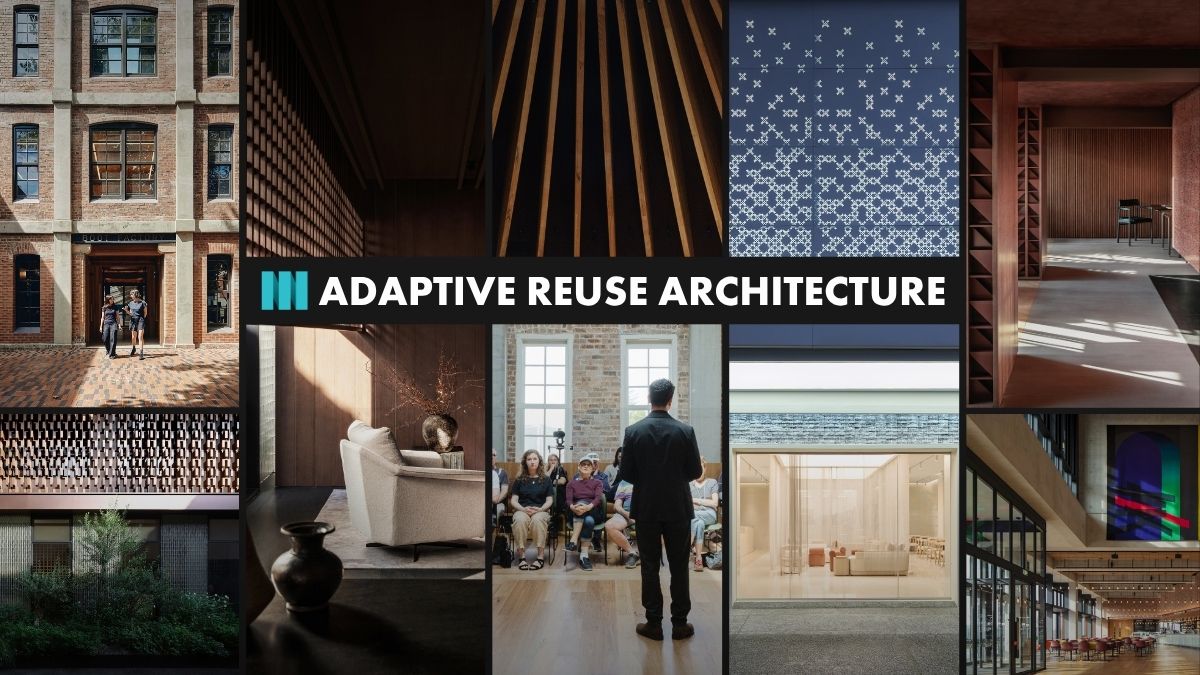
What Is Adaptive Reuse Architecture? 8 AMP 2025 Winners
June 1, 2026Most discussions about architecture focus on what gets built. Adaptive reuse architecture is concerned with something more difficult: what gets kept, and what it becomes.
Adaptive reuse is the practice of repurposing an existing building for a use other than the one it was designed for. A factory becomes a community hub. An abandoned shelter becomes a public art space. A historic house is transformed into a civic institution. The shell remains; the interior logic, the programme, and often the life of the building are entirely reconceived.
It is one of the most demanding disciplines in architecture, requiring designers to work within the constraints of structures they did not create, materials they cannot always verify, and histories that carry obligations. It is also, increasingly, one of the most important. As cities become denser, as the construction industry accounts for a growing share of global carbon emissions, and as communities grow more protective of the built heritage that gives their neighbourhoods character, the case for reuse over demolition has become difficult to argue against.
This guide covers what adaptive reuse architecture actually involves, why it has become a central concern for the profession, what the real challenges look like from a design and delivery standpoint, and eight examples of award-winning adaptive reuse projects recognised by the Architecture MasterPrize (AMP) in the 2025 edition, drawn from six countries across three continents.
What Is Adaptive Reuse in Architecture?
Adaptive reuse means finding a new purpose for an existing building without demolishing it. The term entered architectural usage in the mid-1970s, though the practice is considerably older: buildings have been converted, extended, and reprogrammed throughout history, from Roman baths transformed into churches to Victorian warehouses turned into loft apartments.
What has changed is the intentionality and scale of the discipline. Adaptive reuse is now a recognised area of architectural expertise, with its own body of practice, regulatory frameworks, and increasingly, its own critical discourse. It sits at the intersection of architecture, heritage conservation, urban planning, and environmental strategy.
It is worth clarifying what adaptive reuse is not:
- Restoration returns a building to an earlier state, repairing damage and reinstating original features. Notre-Dame Cathedral’s ongoing post-fire work is an example of restoration.
- Preservation freezes a building at a particular moment in time, protecting its existing condition without necessarily changing its use.
- Renovation updates a building for the same use, improving performance or appearance without changing its programme.
Adaptive reuse is distinct from all three: it changes what a building is for, often substantially, while retaining as much of the original fabric as possible and treating that retention as a design resource rather than a constraint.
“The greenest building is the one that’s already built.” – Carl Elefante, architect and sustainability expert, Forum Journal
Why Adaptive Reuse Architecture Has Become So Important
The carbon argument
The construction industry accounts for approximately 40% of global carbon emissions. A significant portion of that comes not from operational energy use but from embodied carbon: the emissions associated with manufacturing and transporting building materials, and from the demolition of existing structures.
When a building is demolished, the embodied carbon locked into its structure, its concrete, its steel, its masonry, is effectively written off. When a building is adapted rather than demolished, that carbon remains in use. The structural system of a building, which carries the highest embodied carbon of any component, is preserved and put back to work.
A well-documented Milan adaptive reuse project showed 40% lower carbon emissions and 16% lower costs compared to an equivalent new build on the same site. This kind of data is increasingly influencing how developers, institutions, and municipalities think about the built environment. The question is no longer whether reuse is more sustainable than demolition. It almost always is. The question is whether the project economics and design brief can be structured to make reuse viable.
The urban and community argument
Beyond carbon, adaptive reuse addresses something that new construction cannot easily replicate: the quality of existing places. Historic buildings give neighbourhoods their visual identity and their sense of continuity. When they are demolished, that character is gone permanently. When they are successfully adapted, it is carried forward into a new context.
This is not simply a matter of aesthetics. Research on urban regeneration consistently shows that adaptive reuse projects tend to support economic vitality in their surrounding areas more effectively than equivalent new construction. They attract foot traffic, create destinations, and often function as catalysts for broader neighbourhood investment. A converted factory that becomes a community hub or cultural venue generates activity in ways that a new building on a cleared site frequently does not.
There is also a housing dimension that has become increasingly urgent. The conversion of underperforming office stock into residential use has accelerated significantly since 2020, particularly in North American and European cities where office vacancy rates remain elevated. New York City, for example, created a dedicated Office Conversion Accelerator Team to streamline approvals for adaptive reuse projects delivering 50 or more housing units. These are not marginal projects: one Manhattan conversion alone is delivering 571 market-rate apartments from a former Goldman Sachs headquarters.
The design argument
Architects who specialise in adaptive reuse often describe existing buildings as offering design possibilities that blank-site projects cannot. The material texture of an old structure, the proportions of its spaces, the way light enters through windows that were positioned for a different function, all of these become raw material for a new architectural language. The best adaptive reuse work uses the original building’s character as a collaborator rather than a constraint.
The Real Challenges of Adaptive Reuse
Adaptive reuse architecture is frequently discussed in terms of its benefits. The challenges are less often addressed in detail, but architects and clients who underestimate them do so at significant cost.
Structural uncertainty
Existing buildings, particularly older ones, often lack complete documentation. Original drawings may be lost, dimensions may not match what was recorded, and structural members may have been modified over the building’s life without record. Assessing what a building can accommodate structurally, and what it will cost to address deficiencies, is a fundamental early-stage challenge that can significantly affect project viability.
Building code compliance
Codes and regulations are written primarily for new construction. Applying them to existing buildings, particularly historic ones, requires interpretation and often negotiation with local authorities. Fire safety, accessibility, energy performance, and seismic requirements may all demand interventions that affect the building’s character or significantly increase project costs. Different jurisdictions handle this differently: some have developed specific adaptive reuse pathways that offer flexibility; others have not.
Hidden costs
Demolition costs, which can represent 5% to 10% of a total new-build construction budget, are avoided in adaptive reuse. But they are often replaced by discovery costs: asbestos removal, soil contamination remediation, structural remediation, and the cost of working around occupied fabric rather than clearing a site. These costs are difficult to anticipate fully in early-stage budgeting, which is why adaptive reuse projects tend to carry higher contingency allowances than equivalent new builds.
The image problem
A recurring observation among architects working in adaptive reuse is that the profession’s media and award culture has historically favoured new construction. Glossy images of completed new buildings are easier to produce and more visually dramatic than photographs of a conversion project in which the achievement lies partly in what was preserved. This is changing, but slowly. Awards programs that specifically recognise adaptive reuse work, alongside broader architecture awards programs that evaluate it on equal terms with new build, play a meaningful role in shifting that culture.
8 Award-Winning Adaptive Reuse Architecture Projects: AMP 2025
The following eight projects were recognised by the Architecture MasterPrize in the 2025 edition. They cover industrial, civic, cultural, hospitality, heritage, and community typologies across Australia, Belgium, Mexico, Singapore, Ireland, and China. Each represents a different approach to the central challenge of adaptive reuse: how to honour what already exists while making something genuinely new.
1. Boot Factory Community and Innovation Hub
Archer Office | Tomek Archer | Institutional Architecture | AMP 2025 | Australia
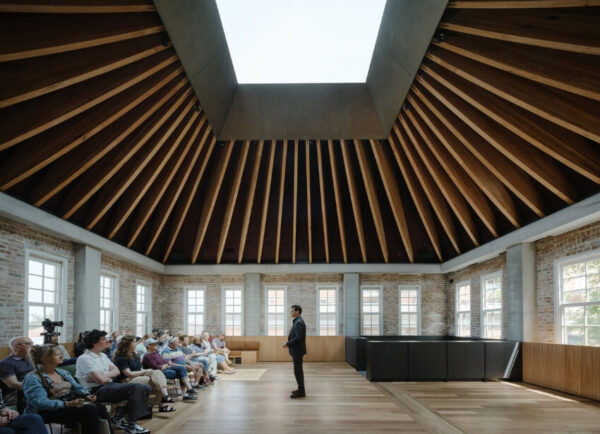
A former boot factory in regional Australia is not an obvious candidate for transformation into a community and innovation hub. The industrial heritage of the building, its robust materiality, its generous floor-to-ceiling heights, and its position within a working-class neighbourhood, were precisely what Archer Office chose to build upon rather than erase. The project retains the factory’s structural character while introducing new programme: collaborative workspaces, community facilities, and flexible event spaces that serve the surrounding population rather than displacing it. The project is a thoughtful example of adaptive reuse architecture in which the building’s history is treated as a social and spatial asset.
View Boot Factory Community and Innovation Hub
2. Reconversion of Hasselt Beguinage
Bovenbouw Architectuur and David Kohn Architects | Joris Willems | Historic Preservation | AMP 2025 | Belgium
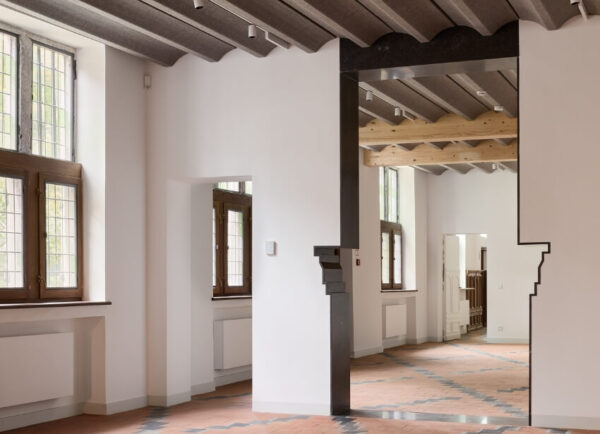
The Hasselt Beguinage is a medieval complex in Belgium, originally built to house Beguines, laywomen who lived in religious communities without taking formal vows. The reconversion by Bovenbouw Architectuur and David Kohn Architects transforms this historic ensemble into a contemporary mixed-use complex while maintaining the spatial logic and material character that give the complex its significance. The project is particularly notable for the precision of its interventions: new elements are legible as new, but they speak directly to the existing fabric rather than competing with it. The Hasselt Beguinage is among the more complex adaptive reuse examples from the 2025 AMP edition, both in terms of heritage sensitivity and programme complexity.
View Reconversion of Hasselt Beguinage
3. Border Library and Public Park
Fernanda Canales | Cultural Architecture | AMP 2025 | Mexico
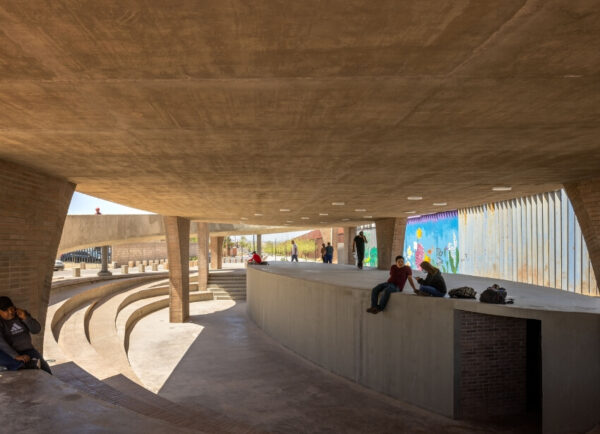
Fernanda Canales’ Border Library and Public Park in Mexico is an adaptive reuse project with an explicitly civic ambition: to create a public institution in a context where public space is scarce and where the relationship between community, territory, and built form carries particular political weight. The project works with an existing structure and its surrounding landscape to establish a library that reads as genuinely rooted in its context, not as an imported cultural gesture. Canales is one of the most rigorous voices in contemporary Mexican architecture, and this project reflects her consistent concern with what buildings owe to the communities they serve.
View Border Library and Public Park
4. Serrangel Art Pavilion
CE-ST Design Studio | Commercial Architecture | AMP 2023 | Singapore
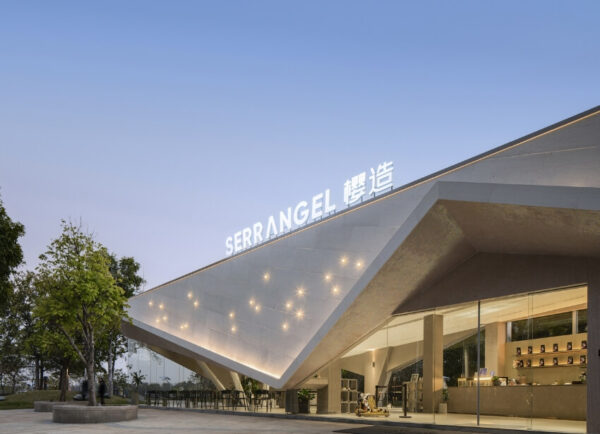
The Serrangel Art Pavilion began as an abandoned public rest shelter in Foshan, China. CE-ST Design Studio’s intervention transforms it into a community art space, its facade clad in recycled glass mosaics that reflect both the client’s commitment to sustainability and the project’s character as a place of visual culture. The project is a compact but precise example of adaptive reuse at a smaller scale: the existing structure defines the spatial possibilities; the new programme and materiality define what those possibilities mean. CE-ST navigated strict refurbishment regulations while producing a space that reads as genuinely new.
5. Renovation of Feria Hotel in Shenzhen Bay
MOZHAO Architects | Guansheng Zeng | Hospitality Architecture | AMP 2025 | China
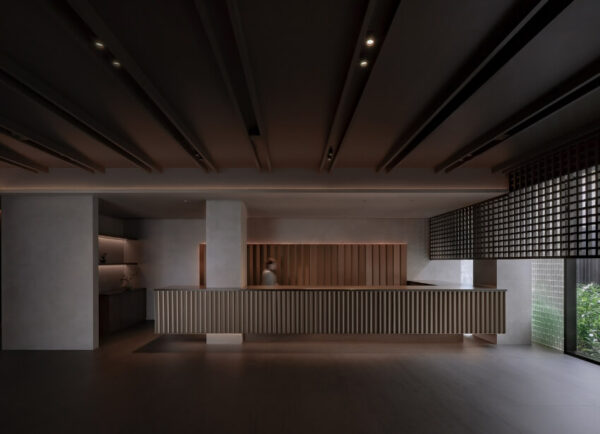
Hotel conversions represent one of the most commercially active areas of adaptive reuse architecture globally, driven by the economics of hospitality development and the attractiveness of existing buildings in established urban locations. MOZHAO Architects’ renovation of the Feria Hotel in Shenzhen Bay approaches the project as a design problem rather than a refurbishment exercise: the existing building provides the structural and spatial framework, and the new interior language is developed to work with and against that framework in ways that produce something coherent. The project demonstrates what adaptive reuse can achieve in the hospitality sector when the brief is approached architecturally.
View Renovation of Feria Hotel in Shenzhen Bay
6. House of Tan Yeok Nee
DP Architects | Chua Zi Jun Ziggy | Historic Preservation | AMP 2025 | Singapore
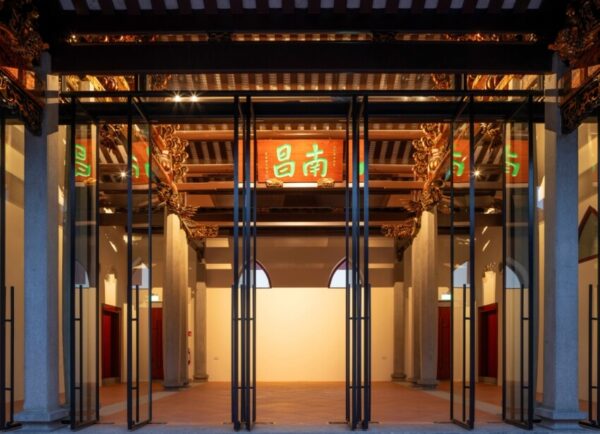
The House of Tan Yeok Nee is one of Singapore’s few surviving Teochew-style courtyard houses, built in the 1880s and listed as a national monument. DP Architects’ work on the building addresses the particular challenge of adaptive reuse for listed heritage structures: how to bring a building into contemporary use while maintaining the integrity of the features that justify its protection. The project is a careful exercise in restraint, allowing the building’s original spatial hierarchy and material character to remain primary while accommodating the demands of a contemporary institutional programme. Heritage adaptive reuse at this level of significance requires a different kind of design intelligence than new construction: the measure of success is what was not changed as much as what was.
7. Rooted Renewal: 94 Cafe
MNI Studio | Ken Chen | Commercial Architecture | AMP 2025 | Singapore
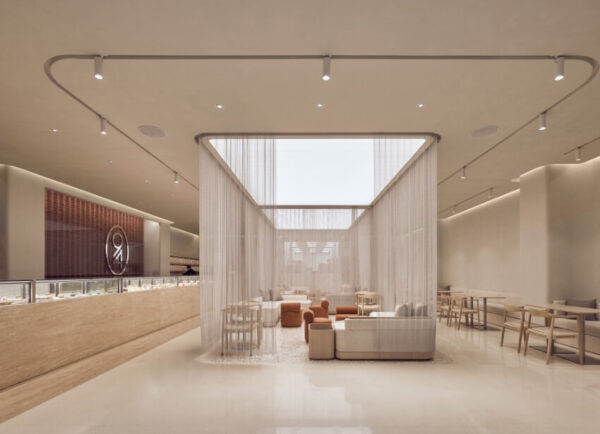
Not all adaptive reuse architecture operates at the scale of public institutions or large heritage complexes. MNI Studio’s Rooted Renewal project demonstrates what thoughtful adaptive reuse can achieve at a smaller, more intimate scale: the conversion of an existing commercial space into a cafe that draws on the material and spatial qualities of what was already there. The project’s title reflects its design philosophy. Renewal that is rooted in the existing fabric rather than superimposed on it tends to produce spaces that feel genuinely embedded in their context, rather than temporally and spatially displaced. This is adaptive reuse as neighbourhood architecture, which is arguably its most socially significant form.
8. Sadler’s Wells Theatre
O’Donnell + Tuomey | Cultural Architecture | AMP 2025 | Ireland
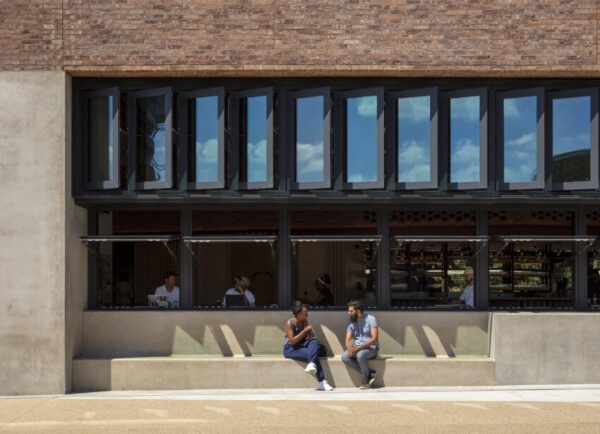
Sadler’s Wells Theatre in London is one of the world’s leading dance venues, with a history on the same Islington site stretching back to the 17th century. O’Donnell + Tuomey’s work on the building is an expansion and renovation that treats the theatre’s layered history as a design resource: successive phases of construction are acknowledged rather than concealed, and the new elements contribute to a spatial narrative that is richer for being evidently accumulated over time. O’Donnell + Tuomey are among the most distinguished practices working in the field of cultural adaptive reuse architecture in Europe, and this project represents a significant addition to a body of work that consistently addresses the relationship between new architecture and existing urban fabric with rigour and intelligence.
What Separates Successful Adaptive Reuse Projects from Unsuccessful Ones
Architects, developers, and urban planners who work regularly in adaptive reuse generally agree on the conditions that determine whether a project succeeds.
- Early structural assessment:
The most common source of cost overruns and design compromises in adaptive reuse is insufficient understanding of the existing building’s structural condition and capacity at the outset. Investing in thorough investigation before committing to a design approach saves time and money later.
- A design brief that respects the existing fabric:
Adaptive reuse projects that try to make an existing building perform in ways it was never designed for, imposing a programme on a structure that cannot accommodate it without extensive modification, tend to produce compromised results. The strongest projects develop their brief in dialogue with what the building offers.
- Material honesty:
The best adaptive reuse architecture makes the relationship between old and new legible. New interventions that pretend to be original, or original fabric that is concealed rather than celebrated, both undermine the spatial and historical intelligence that makes adaptive reuse compelling.
- Community engagement:
Buildings that have been part of a community’s life carry expectations. Adaptive reuse projects that engage with those expectations, understanding what the building means to the people who used it or lived near it, tend to produce outcomes with broader and more durable public support.
Frequently Asked Questions About Adaptive Reuse Architecture
Is adaptive reuse always cheaper than new construction?
Not always, but frequently. Demolition costs, which can represent 5% to 10% of a new-build budget, are avoided. Land acquisition costs are often lower or eliminated. However, discovery costs such as asbestos remediation, structural remediation, and the complexity of working with existing fabric can offset those savings. The financial case for adaptive reuse depends heavily on the specific building, its condition, the scope of the proposed new use, and the regulatory environment. In general, studies comparing equivalent projects show adaptive reuse to be cost-competitive with new construction and significantly more cost-effective on a whole-life carbon basis.
What kinds of buildings are most commonly adapted?
Industrial buildings, particularly factories and warehouses, are among the most commonly adapted building types, partly because their structural simplicity, generous floor heights, and robust construction make them well suited to a wide range of new uses. Religious buildings such as churches and chapels are converted at increasing rates as congregations shrink and buildings become too large or expensive to maintain for worship alone. Office buildings are increasingly converted to residential use, particularly in cities with high housing demand and elevated post-pandemic office vacancy rates. Heritage buildings of all types are candidates for adaptive reuse when their significance justifies the cost of retention.
What is the difference between adaptive reuse and renovation?
Renovation updates a building for the same use: improving its performance, replacing worn-out systems, refreshing its appearance. Adaptive reuse changes what a building is for. A renovated office building is still an office building. An adaptively reused office building might become apartments, a hotel, a school, or a community centre. The distinction matters because adaptive reuse involves a more fundamental reconception of the building’s spatial organisation, programme, and sometimes its relationship to its urban context.
Does adaptive reuse qualify for tax incentives or grants?
In many jurisdictions, yes. Historic tax credits in the United States, for example, can provide significant financial offsets for qualifying adaptive reuse projects involving listed buildings. European national and regional programmes vary widely but often include grants or tax relief for projects that preserve architectural heritage or contribute to urban regeneration objectives. Local governments and economic development agencies frequently offer additional incentives for adaptive reuse projects that deliver housing, community facilities, or jobs in target areas. The availability of these incentives is one reason adaptive reuse project economics are often more attractive than a simple construction cost comparison would suggest.
How does adaptive reuse contribute to reducing carbon emissions?
The primary carbon benefit of adaptive reuse is the preservation of embodied carbon. Every building contains significant carbon emissions in its materials: the energy consumed in manufacturing concrete, steel, glass, and other components is effectively stored in the structure. When a building is demolished, that embodied carbon is written off, and the replacement building requires a further carbon investment. Adaptive reuse retains the embodied carbon and, when combined with improvements to energy performance, can achieve whole-life carbon reductions of 30% to 50% or more compared with demolition and new construction on the same site.
Adaptive Reuse Architecture and the Future of the Built Environment
The International Energy Agency has estimated that 80% of the buildings that will exist in 2050 have already been built. That single figure reframes what architecture’s relationship to the existing built environment needs to be. The discipline cannot decarbonise the built environment primarily by designing better new buildings. It needs to get much better at working with what already exists.
Adaptive reuse architecture is not a niche specialisation or a sustainable add-on to conventional practice. It is, increasingly, a core competency for the profession and a central concern for anyone involved in shaping cities. The eight projects above represent a range of approaches to that challenge, from the conversion of a medieval Belgian beguinage to the transformation of a Singapore heritage house to the reimagining of a factory in regional Australia. What they share is an approach to design that treats existing buildings not as problems to be solved by demolition, but as resources to be understood and worked with.
That approach is not easier than building new. In many respects, it is harder. But the evidence, from carbon accounting, from community impact studies, from the quality of the architecture it produces at its best, suggests it is the more productive direction for the discipline to develop.
Enter the Architecture MasterPrize 2026
The AMP recognises design excellence across architecture, interior design, landscape architecture, and product design, including adaptive reuse and heritage conversion projects. Entries are open from anywhere in the world. The Regular Entry deadline is June 30, 2026.
ENTER AMP 2026